It’s been almost a year since we lost one of the world’s greatest naturalists and animal advocates: Jane Goodall. Of course everyone knowns Goodall for her work with chimpanzees. Do a google image search, and about half the results show her sharing the spotlight with a chimp. But her passion extended to the rest of the natural world, and her outreach was often centered on convincing us humans to understand our place in it.
In an interview with Smithsonian Magazine, Goodall had something remarkable to say about plants, and humankind’s connection with them:
It’s been proven by quite a few studies that plants are good for our psychological development. If you green an area, the rate of crime goes down. Torture victims begin to recover when they spend time outside in a garden with flowers. So we need them, in some deep psychological sense, which I don’t suppose anybody really understands yet.
Jane Goodall, February 2013
This quote is in response to a question about endangered species: “Ecologically, when people think about endangered species, they mostly consider animals. Why should we be concerned about plants?” The underlying point, I think, is that without plants humans may very well end up on the endangered species list as well.
Welcome to Quote of the Week, a series where every Monday I’ll take a look at a notable quotation about plants, gardening, and nature, and explore what it can teach us all about our connection to the garden. This week we’ll be looking at the inimitable Jane Goodall.
“Without Plants, We Wouldn’t Exist.”
Jane Goodall’s quote puts into words what most of us feel innately – that gardening and green spaces have a positive effect on human life. Here’s an article on the Freedom From Torture charity in the UK that focuses on just that. And here’s a study reflecting green space’s ability to lower crime rates. The internet is full of studies and foundations proving Goodall’s point.
What none of them mention is what I believe Goodall is getting at. She says that one of the greatest threats for endangered species is loss of habitat. Losing habitat doesn’t only mean these animals have nowhere to live. (After all, you wouldn’t say they’ve gained habitat with the construction of a new zoo). Habitat loss, for them, means losing the place they can live and thrive.
So aren’t we humans, with every green space we destroy, losing our own habitat? We’re creating a place we can live, sure, but not a place we can thrive.
That’s why, as Dame Goodall says, we need plants in a deep psychological sense. It’s the only way we can really exist in our natural state.
Planting Natural Habitat
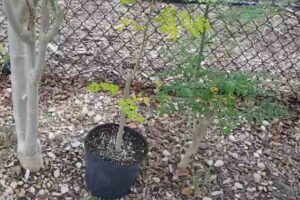
Goodall worked tirelessly to sustain natural habitat, both for wildlife and for human beings. In a truly inspiring Instagram post, a teacher shared photos of two trees Goodall had donated to her school over thirty years earlier. You have to wonder just how many trees are out there that she’s directly responsible for.
Create Your Own Natural Habitat