The front garden is the first thing potential buyers will see. If yours is messy, neglected or just plain boring, it doesn’t make a great first impression. According to a survey carried out by the Society of Garden Designers and Zoopla, 47 per cent of people were put off buying or renting because of the condition of the garden.
What can you do? We asked some expert garden designers for advice on transforming a front garden. These tips are guaranteed to give your home selling appeal, whether you need a quick fix or have time to put in a bit more work and add value to your house.

1: Think bigger, not more
“When it comes to front gardens, one bold statement can have more impact than lots of smaller additions,” says garden designer Tabitha Sibun. “Rather than using clusters of several small pots, consider a single oversized container with a carefully chosen specimen. Some small multi-stem trees (such as Cercis canadensis), fruit trees (Malus ‘Evereste’ or Ficus carica) and Japanese maples can live happily in large pots and provide year-round interest through their attractive structure, blossoms and fruits, or autumn colour. Alternatively, a shrub with a lifted canopy (such as Osmanthus × burkwoodii) can introduce height and drama without overwhelming the space.”

2: Plant up to the path
The path to the front door is one of the most overlooked parts of a front garden, says Tabitha Sibun. “Where space allows, bringing planting right up to the path, rather than confining it to the borders, can have a dramatic impact. Removing occasional paving slabs along a path’s edge can also create pockets for planting. Mid-height planting brings colour, texture and movement closer to the path, softening hard surfaces and creating a stronger sense of arrival before you even reach the front door.”

3: Fill it with flowers
“My favourite option will always be to fill the space with flowers,” says award-winning garden designer Jo Thompson. “I love two simple beds on either side of a central path leading to the door, with some not-too-complicated topiary to give height, and a pretty porch frame around the front door to support climbers. Peonies, roses, foxgloves and campanulas – the cottage dream. Yes, it takes more looking after, but just imagine people’s reaction as they walk by.”

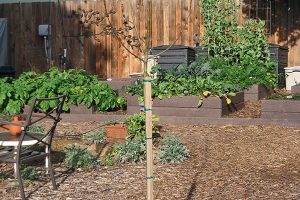
4: Add a tree
A flowering tree, like a magnolia or a cherry, is a simple way of adding impact to a front garden. “A front garden does not need a complicated design,” says Jo Thompson. “Simple is almost always best. Focus on making sure the materials and planting palette work with the house rather than against it. And ask yourself: is there room for a small tree? A blossoming tree in a front garden creates a sense of privacy and brings a real zing to the street scene.”
“Choose something that blossoms in the spring,” says award-winning designer Pollyanna Wilkinson, “and turns beautiful shades of orange and red in autumn, such as Cornus kousa, cherry blossom or Malus. It’s a wonderful way of celebrating the seasons.”

5: Get rid of the lawn
A small lawn is high maintenance. Pollyanna Wilkinson says: “Lawn serves little purpose in front gardens, other than being another thing you need to mow! Instead, swap any lawns for generous planting borders and you instantly transform a void into a mass of beautiful and seasonal planting.”
Garden designer Karl Hammond agrees. “If the front lawn is small, patchy or rarely used, consider removing it altogether and creating a planting-led front garden instead. Naturalistic perennials and ornamental grasses can bring seasonal interest, movement and colour, while also making the entrance feel more considered and less maintenance-heavy than a struggling lawn.”

6: Limit your plant palette
One way to improve the look of your planting is to restrict the number of plant varieties you use. “Less is more,” Pollyanna Wilkinson says. “If you want to add a sense of formality to your front garden, then creating planting borders which use a limited palette of plants, repeated, rather than lots and lots of different plants, will instantly feel more considered.”
More design tips
- For sunny front gardens, Karl Hammond suggests treating the space as an area to enjoy rather than just pass through. “A small seating area, gravel courtyard or Mediterranean-style planting scheme can create a welcoming place for morning coffee, while also adding character and kerb appeal.”
- “If you can’t fit in borders, what about adding two really generous pots either side of your front door?” Pollyanna Wilkinson says. “The bigger the better, and aim for them to be relatively tall so the planting is at waist high or above, rather than dragging the eye down to the ground.”
- Plant around the base of the house to ‘settle it in’, garden designer Debbie Roberts says. It’s known as ‘foundation planting’. This helps soften the line between the garden and the house.
- “Only pave or gravel the area needed for car parking and plant the rest,” says Debbie Roberts.
Advice from:
- Garden designer Tabitha Sibun, Fieldhouse Studio, fieldhousestudio.co.uk
- Jo Thompson writes The Gardening Mind, her weekly Substack newsletter – the place to go to read more from Jo on planting, design, and seasonal inspiration.
- Pollyanna Wilkinson runs the design practice Studio Pollyanna and writes a substack newsletter, The Well Dressed Garden
- Karl Hammond, Arbor & Fern Garden Design, arborandfern.co.uk
- Debbie Roberts, Acres Wild, acreswild.co.uk