
by Bethany Hayes (revised and updated)
The 30-second version: Core gardening means burying a long “core” of spongy organic material — straw, hay, leaves, wood, food scraps — down the middle of a raised bed, then covering it with good soil and planting on top. You soak (“charge”) that core once, and it holds water like a sponge, wicking moisture outward to your plants’ roots so you water far less often than usual. It’s cheap, simple, you can plant the same day you build it, and it gradually improves your soil. Think of it as a lighter, flatter cousin of hugelkultur that still looks like a normal garden bed.
What is core gardening?
The idea is simple: instead of relying on the whole bed to hold water, you build a concentrated reservoir of moisture-holding material down the center. You dig a trench through the middle of a raised bed, pack it with organic matter like straw and leaves, bury it under several inches of good soil, and plant as usual. Once you saturate that buried core, it behaves like a sponge — slowly releasing moisture sideways into the surrounding soil throughout the season.
The result is a bed that stays evenly moist with far less watering on your part. You’ll often see core gardening described as a dryland technique inspired by traditional desert growing — burying grass in trenches and covering it with soil to trap scarce water. Whatever its exact origins, the principle is sound and easy to try, and it pairs the water-holding idea of hugelkultur with a flatter, tidier bed that doesn’t need big mounds or as much material.
Why try core gardening?
You water much less. This is the big draw. Once the core is charged, the bed pulls moisture from that buried sponge instead of needing daily watering — so depending on your climate, soil, and weather, you can stretch the time between waterings considerably. (In a cool, humid season you might water rarely; in blistering heat you’ll still need to check and water more, so treat “every couple of weeks” as a best case, not a guarantee.)
It’s cheap. The core is mostly free material you already have — grass clippings, leaves, kitchen scraps, twigs. A small upfront effort, little to no cost.
No waiting to plant. Unlike methods where you wait for material to break down first, the core’s job is to hold moisture, not to decompose into nutrients before planting. You can build the bed and plant the same day.
It improves your soil over time. As the buried organic matter slowly breaks down, it feeds the bed and improves structure, so the soil drains well while still holding moisture — exactly what most roots want.
It’s simple. Bed, trench, fill, cover, soak. There’s not much to get wrong, which is a big part of why people like it.

How to build a core garden
1. Start with a raised bed
Core gardening works best in a raised bed, because the contained space helps the core spread its moisture evenly rather than dissipating. Any size or material works — if you already have beds, you’re ready to go. (It can be done in-ground too, but raised beds make the wicking far more effective.)
2. Cover the ground underneath
Lay cardboard across the bottom of the bed. It smothers the grass and weeds below and breaks down over time, adding organic matter. I prefer cardboard over landscape fabric, which never decomposes, adds nothing to the soil, and tends to cause problems down the road.
3. Add a few inches of soil (deep beds only)
If your bed is deeper than about 12 inches, add a few inches of soil at the bottom first — roughly filling the lower quarter — so the core ends up at the right height. For shallower beds, skip this step.
4. Dig and fill the core
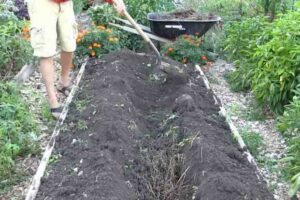
This is the heart of the method, so get it right. Dig a trench about eight to ten inches deep running lengthwise down the center of the bed. Keep it centered and low — too high in the bed and the moisture won’t spread properly.
The core spreads moisture roughly two feet in each direction, so for a wide bed you’ll want a second core (or a larger one) to reach all the soil. Fill the trench with at least four to five inches of mixed organic material — the variety is what makes it work well and feeds the soil as it breaks down:
- Straw and hay
- Dried grass and plant cuttings
- Shredded leaves
- Wood chips, bark, twigs, and small branches
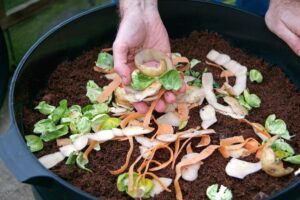
- Food and fruit/vegetable scraps
- Coffee grounds
- Composted manure
5. Cover with good soil
Bury the entire bed, core included, under a quality soil mix — ideally a homemade blend of compost and soil, or a good purchased mix. Aim for about five inches of soil over the top of the core.
6. Plant right away
There’s no waiting period — plant as soon as the bed is filled. And don’t fuss over where the core sits; plant across the whole bed normally. The moisture spreads sideways, so everything benefits.
7. Charge the core
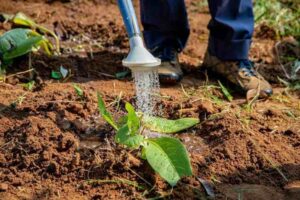
This step is essential, and skipping it is the main reason the method fails. You have to thoroughly soak the buried core to start. With drip or soaker irrigation it’s easy; by hand, work the hose down toward the core in several spots along the bed and let it run for several minutes each until the core is fully saturated. From then on, the bed draws on that reservoir and you water much less.
8. Mulch the top (optional but worth it)
Finish with a few inches of mulch — grass clippings, wood chips, or compost — over the soil. It slows evaporation from above, suppresses weeds, and steadies soil temperature, so the moisture you stored in the core lasts even longer.
Common Questions
How much less will I really have to water?
A lot less, but the exact interval depends on your climate, soil, and weather. The core keeps the bed evenly moist between waterings; in mild conditions that can mean watering only every week or two, while in extreme heat you’ll still need to check regularly and water more. The savings are real — just not a fixed schedule.
Do I have to use raised beds?
It works best in them, because the contained space helps the core wick moisture evenly. You can adapt it to in-ground beds, but expect it to be less efficient.
Can I plant directly over the core?
Yes. Plant across the whole bed as normal — the moisture spreads sideways about two feet, so there’s no need to plant around the core.
What if I skip charging it?
Then it won’t work. The whole method depends on that initial deep soak to fill the sponge. Saturate it thoroughly the first time, and the core does the rest.
Final Thoughts
Core gardening is one of the easiest ways to grow more with less effort and water. Build a raised bed, bury a sponge of organic material down the middle, soak it well, and plant — then enjoy watering far less often while your soil quietly improves season after season. It’s cheap, simple, and forgiving, which makes it a great method to try if frequent watering is what’s kept you from gardening.
Learn More
The post Core Gardening Method: Grow More with Less Work and Water appeared first on Gardening Channel.